

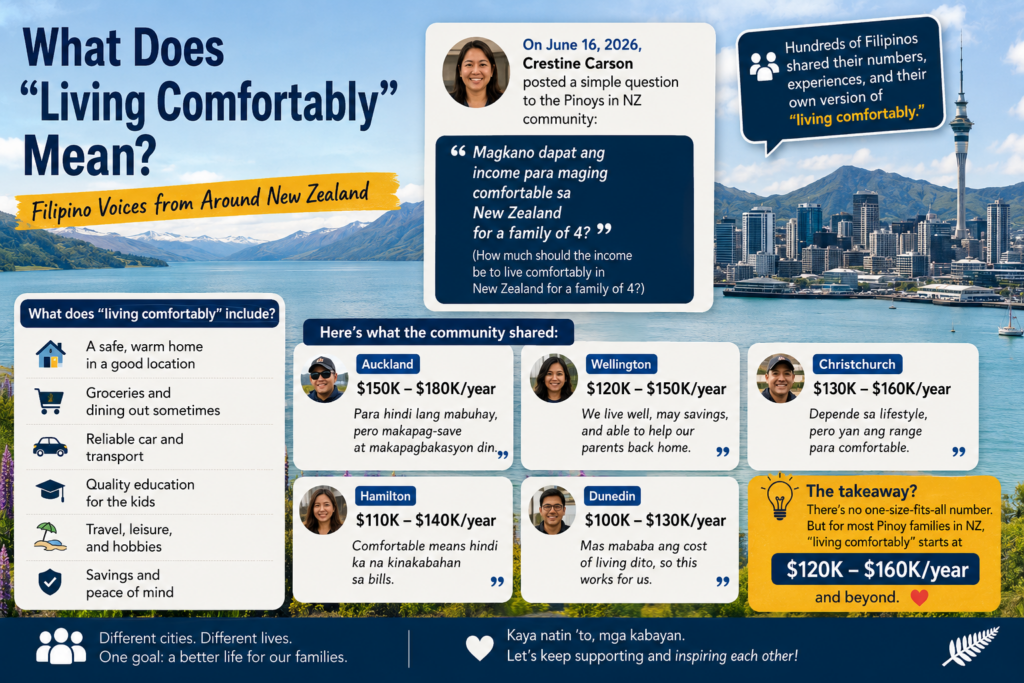
On June 16, 2026, Crestine Carson posted a simple question to the Pinoys in NZ community:
“Magkano dapat ang income para maging comfortable sa New Zealand for a family of 4?” (How much should the income be to live comfortably in New Zealand for a family of 4?)
It struck a nerve. The post pulled in 321 comments, 116 likes, and 93,819 views, and the answers ranged from blunt numbers to detailed household budgets to “it depends” philosophy. Partway through, Crestine followed up with a more pointed ask:
“Please share yung current situation nyo here and tips to live comfortably without overspending kasi marami nagtatanong.” (Please share your current situation here and tips to live comfortably without overspending, since a lot of people are asking.)
That’s when the real numbers started coming in. Here’s what our kababayan actually said.
The First Question Back: “Comfortable for Who?”
Before anyone gave a number, several commenters pushed back on the question itself.
UnforgettableWolf7275 asked the obvious thing first:
“For single person or family?”
MagentaDeer4394 called the question too broad to answer with one figure:
“Subjective ang tanong. Depende sa tao yan at sa pangangailangan nila.” (The question is subjective. It depends on the person and their needs.)
Thelma C. added a cost-of-living layer to that:
“Kung isa lng po magwowork mahirap. Pero depende pa rin po kung papano kayo gumastos. Now adays po kasi mataas na lahat ang bilihin, di kagaya nung di pa nag covid.” (If only one person is working, it’s hard. But it still depends on how you spend. Nowadays, prices are high for everything — not like before COVID.)
The pattern was clear early on: before people would commit to a peso or dollar figure, they wanted to define the terms.
“You Can Earn Six Figures and Still Struggle”
The comment that pulled the most reactions (62) reframed the whole question. AnonAucklander wrote:
“I’d say it purely depends on your lifestyle and how you will define ‘comfortable.’ You can be earning 6 digits annually and still struggle or earning less and actually thriving.”
That tension runs through the entire thread — and the actual numbers people shared back it up.
The Numbers People Actually Gave
Once Crestine asked for real budgets, the thread turned into something genuinely useful: a crowdsourced snapshot of what families are earning, spending, and saving across the community.
The mortgage question changed everything. OptimisticRadish675 drew the clearest line in the whole thread:
“With mortgage – atleast 200k household. Without mortgage – atleast 140k household.”
That $60,000 gap shows up again and again in the replies — homeownership (and the debt that comes with it) is one of the biggest swing factors in what “comfortable” costs.
One income, tight but workable. CleverCherry2956 shared a full one-income breakdown for a family of four:
“Si mister lng my work. $3500 sahod per month. Nagkakasya naman, pero kelangan ng budget lalo sa pagkain.” (Only my husband works. $3,500 salary per month. It’s enough, but we need to budget, especially for food.)
Her monthly gastos (expenses): $1,000 grocery, $450 electric bill, $80 internet, $600 bank loan — with what’s left going toward eating out, extra groceries, and the occasional outing. She also noted her own shopping budget is separate, and she doesn’t ask her husband for it.
A wider income range, same conclusion. Heart6256 described a similar single-income household, but with more breathing room:
“Family of 4 sa ngayon isa palang nag wowork, 1,400–1,850 per week ang income, nakaka survive at kahit papaano nakakapag save na, kakain mo lahat ng gusto mo at the same time may na-iipon.” (Family of 4, only one currently working, income of $1,400–$1,850 a week — manageable, and somehow still able to save, eat what you want, and build up savings at the same time.)
Her rule of thumb: “Budget is the key. Kapag maluho kayo, mahihirapan kayo mag-adjust ng expenses.” (Budget is the key. If you live extravagantly, you’ll struggle to adjust your expenses.) Her family saves $300–$400 a week.
The combined-income comfort zone. WillowSnow13 offered a dual-income perspective:
“Earning a combined annual income of 140K. Family of 4. We’re able to save naman po $400 a week, may budget na din for weekend na gala. For us, comfortable na po compared nung nasa Pinas.”
Her advice echoed Heart6256’s almost exactly: “The key talaga is to monitor/track where money is going.”
Other figures dropped into the thread:
- Ugene Togs: “$130k”
- Alberto A. Jr.: “$2000 na sahod a week for the breadwinner” (roughly $104,000/year from one income)
- Jo Jit broke down a household budget by line item: house rent $2,400, water $100, electricity $300, internet $100 (per month — the rest of the list continues beyond what’s been captured so far)
Put together, the numbers people actually cited for a family of four cluster roughly between $130,000 and $200,000+ a year, with mortgage-free households and disciplined budgeting often landing comfortably on the lower end of that range.
Regional Differences
This is the one piece of the puzzle the thread flagged but didn’t fully answer yet. Beth Morales put it plainly:
“Depending po kung saan city at kung you own a house.” (Depending on which city, and whether you own a house.)
It’s a theme that lines up with everything above — the mortgage/rent divide came up repeatedly, and city cost-of-living differences (Auckland vs. smaller centres) were clearly on people’s minds, even if specific city-by-city figures haven’t surfaced yet in what we’ve captured.
What the Research Says, City by City
Beth Morales was right to flag city and homeownership as the two biggest variables. We pulled current 2026 cost-of-living data to see how that plays out in real numbers — and it lines up closely with what the community shared above.
Estimated monthly essentials for a family of four (rent + groceries, transport, utilities):
| City | Estimated monthly cost | Estimated annual cost |
|---|---|---|
| Auckland | $8,100 – $10,800 | ~$97,000 – $130,000 |
| Wellington | $7,800 – $10,300 | ~$94,000 – $124,000 |
| Christchurch | $7,100 – $9,400 | ~$85,000 – $113,000 |
| Hamilton | $6,800 – $9,100 | ~$82,000 – $109,000 |
That’s essential spending only — before savings, debt repayment, or padala home. Stack a savings goal on top of those numbers and you land very close to the $130K–$200K range the community cited. Auckland and Wellington sit at the top almost entirely because of housing, not because of groceries or petrol, which stay fairly consistent nationwide.
A few things worth knowing if you’re weighing where to settle:
- Auckland is the most expensive by a clear margin, driven almost entirely by housing. As a rule of thumb, a single earner renting a one-bedroom flat in Auckland needs roughly $112,800 a year just to stay under the commonly used “rental stress” threshold of spending no more than 30% of gross income on rent.
- Christchurch and Hamilton consistently offer the best value among the main centres. Christchurch’s post-earthquake housing rebuild created more supply, which has kept rents meaningfully lower than Auckland or Wellington. Hamilton, about 80 minutes from Auckland, has become a popular option for people who want lower housing costs without leaving the upper North Island.
- Dunedin is the most affordable of the bigger centres, though wages there tend to run lower and winters are colder — which brings its own cost in heating.
- Electricity costs vary more by region than people expect. The national average is around 40.6c/kWh, but Christchurch tends to run cheaper (around 35c/kWh) while some rural areas exceed 50c/kWh — worth factoring in if you’re comparing a city move against staying put.
- Wellington’s public transport can offset some of its high rent, since a higher share of residents use Metlink instead of running a car. Outside Auckland and Wellington, most of New Zealand is car-dependent, and that adds $400–$750 a month in fuel, insurance, WOF, and registration that doesn’t show up in a simple rent comparison.
The practical takeaway: the same household income can feel completely different depending on the city. A combined $140K that feels comfortable in Hamilton or Christchurch may feel tight in central Auckland — which is exactly the pattern Beth Morales and the OptimisticRadish675 mortgage/no-mortgage comment both pointed at, just from two different angles.
Sources: MBIE Tenancy Bond Data (Jan 2026), Stats NZ Household Economic Survey, Electricity Authority NZ, and 2026 cost-of-living market reports.
Lessons Learned
A few things came through clearly once people started sharing real budgets instead of just opinions:
1. Homeownership status moves the number more than almost anything else. The $200k (with mortgage) vs. $140k (without) split from OptimisticRadish675 was echoed throughout the thread — debt load, not just income, defines “comfortable.”
2. “Budget is the key” wasn’t just advice — it was the most repeated phrase in the thread. Multiple respondents, independently, said the same thing: track where the money goes, and comfort follows.
3. One income can work, but it requires real discipline. Both CleverCherry2956 and Heart6256 described single-income households of four getting by — and even saving — but only with a clear food and household budget.
4. Comparison to the Philippines reframes “comfortable” for a lot of respondents. WillowSnow13’s comment — that $140K feels comfortable compared to life back home — was a quiet but recurring benchmark across answers.
5. Personal budgets matter, not just household ones. CleverCherry2956’s note about keeping her own shopping budget separate from the household money is a small detail, but it points to something bigger: comfort isn’t just about the total number, it’s about having some autonomy within it.
At the end of the day, “comfortable” means different things to different people.
For some, comfort means being able to pay the bills without stress.
For others, it means owning a home, travelling, helping family back home, or giving their children better opportunities.
Some people are content with a simple life. Others are more ambitious and want more freedom, more choices, and more room to grow.
Personally, my biggest definition of comfort is freedom.
Freedom to do more of what I love.
Freedom to spend time with the people who matter.
Freedom to serve, build, create, and live with less financial pressure.
And this is why I personally believe we cannot rely on only one income source anymore. For many families, one income is risky. Even two incomes can still feel tight when the cost of living keeps rising.
Yes, saving is important. We should all learn how to budget, avoid overspending, and build an emergency fund.
But saving alone is usually not enough.
Saving is like storing your money.
Investing is how you allow your money to grow.
The challenge is, many people feel confused about where to start. There are so many opportunities today — property, shares, business, side hustles, online income, digital products, and many more. The world is full of options, but too many options can also make people feel stuck.
So maybe the question is not just:
“How much income do we need to live comfortably?”
Maybe the better question is:
“What kind of system can help our family build a more secure and free life?”
At Pinoys in NZ, this is why we continue to share different opportunities for our community — not because there is only one way, but because every family deserves to see what is possible.
Start simple:
Track your expenses.
Live within your means.
Build savings.
Learn how to invest.
Look for ways to increase your income.
And most importantly, become a wiser consumer.
Because what if your everyday spending could also become part of a wealth-building system?
What if the products you already use at home — skincare, health products, coffee, household items, and daily essentials — could become part of a smarter way to consume, share, and build long-term income?
Personally, I have built multiple income streams over the years, but one of my favourite and simplest lessons is this:
Be a wise consumer.
Do not just spend.
Spend with intention.
Choose quality.
Choose value.
Choose systems that can help you and your family grow.
If you are curious about how to build wealth from your day-to-day consumption and become a wiser consumer, click below to learn more.
Click here to learn about becoming a wais na consumer.