
Parents’ Corner: Teenagers in NZ
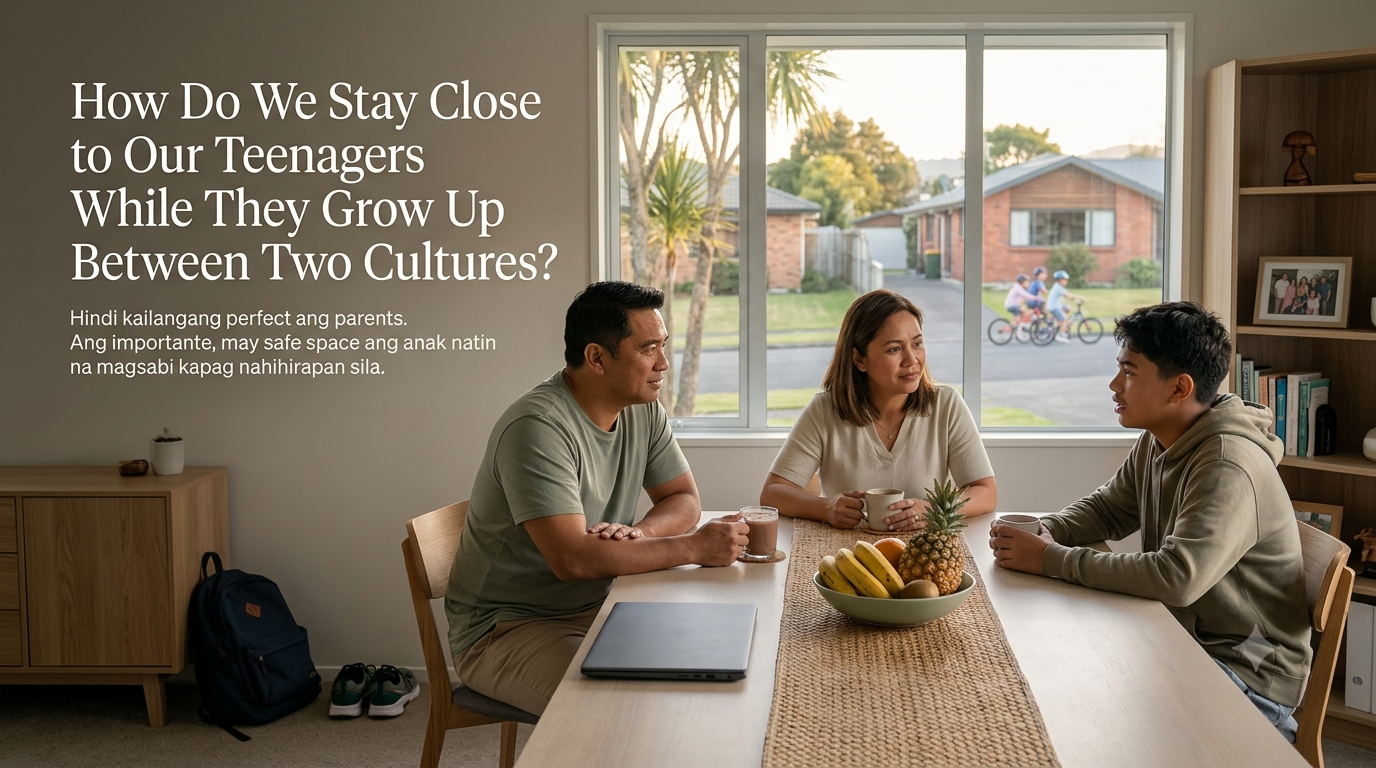
“Hindi kailangang perfect ang parents. Ang importante, may safe space ang anak natin na magsabi kapag nahihirapan sila.”
Raising a teenager is never simple. Raising one in a country your own parents never lived in, with a school system, social media landscape, and set of unspoken rules that feel completely different from how you grew up — that’s its own kind of challenge, and one many Filipino parents in New Zealand are quietly carrying.
This isn’t a piece about what’s going wrong with young people. It’s about how we, as parents, stay close to our teenagers while they figure out who they are — Filipino at home, Kiwi at school, and something entirely their own in between.
Social Media and Online Exposure
Our teenagers are growing up with a level of online exposure most of us never had. That’s not automatically a bad thing — it’s also how they connect with friends, explore interests, and sometimes even reach out for help. But it does mean they’re absorbing a lot, at a pace that can be hard for any parent to keep up with.
You don’t need to understand every app or trend to stay involved. Asking genuine, curious questions — “what’s something funny you saw online today?” — tends to open more doors than “how much time have you spent on your phone?” If something concerning does come up, like harassment or something that feels unsafe, Netsafe (0508 638 723, netsafe.org.nz) is a free, confidential service specifically for online safety issues, including bullying and harmful content.
Bullying and Peer Pressure
Bullying is a real issue in New Zealand schools — research places Aotearoa among the higher-bullying-rate countries in the OECD, with around a third of students reporting being bullied at least a few times a month. That’s not a comment on any particular school; it’s simply the environment our teenagers are navigating, on top of the ordinary pressure of trying to fit in.
For Filipino teens specifically, peer pressure can carry an extra layer — the pressure to fit into Kiwi social norms while also living up to expectations at home. Watch less for dramatic warning signs and more for quiet ones: a teen who used to talk about school and suddenly doesn’t, or who seems to dread certain days of the week. A simple, non-judgmental “you seem a bit off about school lately, want to tell me about it?” often works better than direct questioning.
Gaming, Isolation, and Screen Time
Gaming and screens get a lot of blame, but the real issue is rarely the screen itself — it’s what’s happening (or not happening) around it. A teen who games with friends after finishing homework and still shows up for family dinner is in a very different place than a teen who’s retreated into their room and stopped wanting to be around people.
Rather than setting hard limits as the first move, try staying curious about what the screen time is giving them — connection, escape, achievement, control — and address that underlying need directly. If isolation seems to be deepening rather than easing, that’s worth a closer conversation, and possibly outside support.
Mental-Health Conversations
This is often the hardest one for Filipino families to talk about, and that’s understandable — mental health wasn’t always openly discussed in the culture many of us grew up in. But New Zealand data shows youth mental distress has been rising steadily over the past decade, and young people themselves consistently say they want the adults in their lives to ask, directly and without judgment, how they’re really doing.
You don’t need the perfect words. “I’ve noticed you’ve seemed a bit down lately — I just want you to know you can talk to me about anything” is enough to open a door. If your teen does open up about serious distress, take it seriously rather than reassuring it away, and know that asking for outside help isn’t a failure on your part — it’s exactly what a good parent does.
The Cultural Gap Between Filipino Parents and NZ-Raised Teens
Many of our teens are growing up with values that don’t always match ours — more direct communication, more independence, more comfort saying “no” or disagreeing with an elder. This can feel, at times, like a loss of respect. Often, it isn’t. It’s simply the culture they’re being raised in, layered on top of the one they’re also inheriting from us.
The families who seem to navigate this best don’t force a choice between “Filipino” and “Kiwi.” They let both exist — respect for elders alongside room to disagree respectfully; family obligation alongside personal boundaries. It’s less about winning the cultural difference and more about staying curious about how your teen is making sense of both worlds.
How to Create a Home Where Children Can Speak Honestly
Kids and teens are far more likely to talk when they trust that talking won’t lead to immediate punishment, lecture, or shutdown. That doesn’t mean no consequences — it means separating the conversation from the consequence, at least at first.
A few things that tend to help: reacting calmly to hard truths (even when it’s difficult), thanking them for telling you before addressing the issue itself, and making it clear — repeatedly, not just once — that no topic is too much or too shameful to bring to you. Many teens say they didn’t tell their parents something not because they feared punishment, but because they didn’t want to disappoint them. That’s worth remembering the next time a hard conversation comes up.
When to Ask School, GP, Counsellors, or Community Services for Help
You don’t have to wait for a crisis to ask for support, and doing so isn’t a sign that you’ve failed as a parent. Some signs worth reaching out about: a noticeable drop in school performance or attendance, withdrawal from friends or activities they used to enjoy, big changes in sleep or eating, or your teen directly telling you they’re struggling.
Where to start:
- School: Deans, form teachers, and school counsellors are often the first to notice changes in a teen’s day-to-day behaviour, and can loop in extra support.
- GP: Your family doctor can assess physical and mental health together, and refer to specialist services if needed.
- Youthline – free call 0800 376 633, free text 234, or webchat at youthline.co.nz — for young people and for parents who want guidance on how to support them.
- 1737 – free call or text, 24/7, for confidential support from a trained counsellor (for you or your teen).
- Asian Family Services – 0800 862 342 — confidential support in multiple languages for Asian communities in New Zealand, including Filipino families.
- What’s Up – 0800 942 8787, for tamariki and rangatahi aged 5–18.
- Netsafe – 0508 638 723, for bullying, harassment, or harmful content online.
If your teen ever talks about wanting to hurt themselves or not wanting to be alive, take it seriously and get support immediately — call or text 1737, or the Suicide Crisis Helpline at 0508 828 865, both free and available 24/7.
The Heart of It
You don’t need to have all the answers. You don’t need to be a perfect parent, or a parent who somehow blends Filipino and Kiwi culture flawlessly. What your teenager needs most is simpler than that: a home where it’s safe to say “I’m not okay,” and a parent who responds with love instead of alarm.
Hindi kailangang perfect ang parents. Ang importante, may safe space ang anak natin na magsabi kapag nahihirapan sila.
📬 Subscribe to the Newsletter
More from Parents’ Corner — real conversations, research-backed guidance, and support for Filipino families raising teens across New Zealand. Subscribe to the newsletter so you don’t miss the next one.
[Subscribe Now →]
This article is general information and not a substitute for professional advice. If you or your teenager are going through a difficult time, please reach out to the services listed above — support is available, and asking for it is a sign of strength, not failure.
Sources: Mental Health Foundation of New Zealand; Te Hiringa Mahara (Mental Health and Wellbeing Commission); Ministry of Social Development, Youth Health and Wellbeing Survey; Youthline NZ.